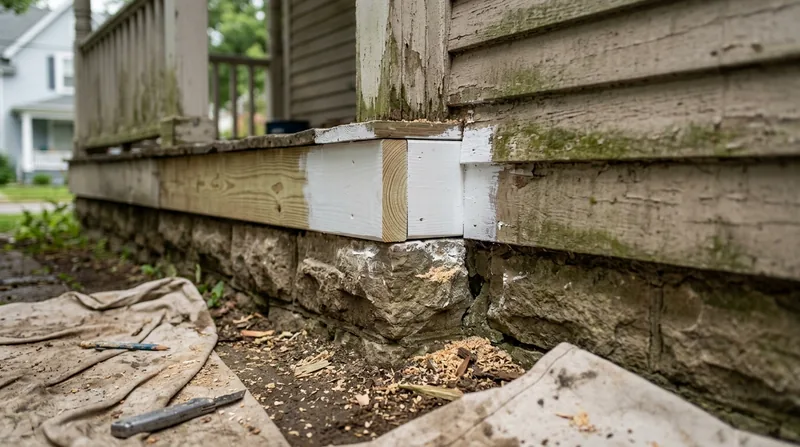




Lexington's humid summers, wet springs, and winter freeze-thaw cycles create ideal conditions for wood rot to take hold in the city's Victorian porches, Craftsman bungalows, and older brick townhouses around Gratz Park and the historic districts. The Inner Bluegrass terrain sits on limestone karst, and most older homes rest on damp crawlspaces or fieldstone basements that absorb water after heavy spring rain, pushing moisture up through sill plates and rim joists. Water finds its way into end grain on deck boards and porch steps, into paint joints on fascia and soffit, and into window frames where repeated freeze-thaw cycles crack the seal. Wood rot and dry rot repair stops that decay before it spreads into structural framing, but the work must be done right: cut out the soft wood, treat the surrounding timber, and rebuild with rot-resistant lumber. This is a permanent fix, not a cosmetic patch. We explain what we find, propose repair when the wood justifies it, and replace only what has truly failed.
Why Wood Rot Threatens Lexington's Historic Homes and Older Neighborhoods
Lexington's architectural character depends on wood. Victorian and Queen Anne houses with deep wooden porches in Bell Court and Woodward Heights; Craftsman bungalows and American foursquares in Kenwick; Tudor and Colonial Revival homes on the curving streets of Ashland Park and Chevy Chase. All of them have wood trim, sill plates, porch posts, and fascia exposed to Lexington's climate. The city averages 45 inches of annual precipitation, concentrated in spring, and humidity runs high through summer and fall. When water sits in wood grain, cellulose begins to break down. Soft rot and dry rot follow. Left untreated, decay spreads into floor joists, subfloors, and structural framing, turning a $1,500 porch-post repair into a $15,000 structural rebuild.
- Porch posts and rim joists fail first because they sit closest to ground moisture and seasonal water intrusion.
- Window frames and exterior trim rot when paint cracks and water wicks into end grain, especially on north-facing exposures.
- Fascia and soffit decay when gutters clog or downspouts drain too close to the house, keeping wood wet for weeks after rain.
- Subfloors and floor joists in older crawlspaces absorb moisture from damp soil, promoting decay that shows up as soft spots and sagging floors above.
- Deck boards and porch steps split and rot fastest because they drain poorly and freeze and thaw repeatedly through winter.
Catching rot early and removing only the damaged wood preserves the character and structural integrity of Lexington's older housing stock.
Key info: In Lexington's damp crawlspaces and basements, subterranean termites and moisture work together. Termite damage and wood rot often occur in the same house. If you have a pest inspection report showing termites, have a carpenter assess the wood condition. See our Termite Damage Repair service for details.
How We Repair Wood Rot and Dry Rot in Lexington Homes
Our process is straightforward: identify the decay, remove all soft wood and treat the sound wood surrounding it, then rebuild with lumber that resists rot. We do not use cosmetic fillers or surface treatments. We cut out the problem, work carefully to preserve sound framing whenever possible, and install new wood that will last. For porch posts, window frames, fascia, and sill plates, we often sister new lumber alongside the old, creating a hybrid repair that keeps the original character while restoring function. For subfloors and joists, we replace the damaged section and tie it into the existing framing with proper fastening and bearing support.
- We probe the wood with a screwdriver to map the extent of decay and determine how much must come out.
- We cut and remove all soft, discolored, or punky wood, staying well back into sound timber to ensure no decay remains.
- We treat exposed sound wood with a wood preservative to arrest any incipient decay and protect the cut faces.
- We measure and cut new lumber to fit the cavity, using rot-resistant species such as redwood or pressure-treated Douglas fir where the repair will see ongoing moisture exposure.
- We install the new wood with corrosion-resistant fasteners, ensuring proper bearing and alignment so the repair carries its design load.
- We finish the repair to match the existing trim profile, paint, or stain so the work disappears into the house.
The entire repair is permanent and carries no cosmetic compromise if done correctly.
Local example: A Victorian townhouse in Gratz Park has a rotted sill plate under a bay window on the north side. Water ran down the brick for years, and the wood underneath softened. We cut out the bad sill, treat the rim joist and subfloor above, sister in a new pressure-treated sill, and seal the brick-to-wood joint with proper flashing. The repair takes 2 to 3 days, costs from $1,200 to $1,800, and stops water from entering the crawlspace for decades.
| Approach | Description | Best for |
|---|---|---|
| Localized removal and replacement | Cut out decay, remove only the soft wood, install new lumber in the cavity, finish to match existing trim. | Porch posts, window frames, fascia, small sections of trim or siding where decay is confined to one area. |
| Sistering | Install new rot-resistant lumber alongside compromised wood, fastening the two together to create a composite member. | Porch posts, rim joists, floor joists, and structural trim where the old wood retains some capacity and historic appearance matters. |
| Full member replacement | Remove the entire compromised member, install new lumber of the same species and profile, tie into existing framing with proper bearing and fastening. | Subfloor sections, floor joists, rim joists, or structural posts where decay is extensive or the member is no longer sound. |
| Preventive treatment and sealing | Apply wood preservative to exposed cut faces and vulnerable areas, install proper flashing, caulk joints, and address drainage to stop future water intrusion. | All repairs, plus ongoing maintenance of sill plates, window frames, deck boards, and exterior trim to prevent recurrence. |
Wood Rot and Dry Rot Repair Cost in Lexington: What to Expect
Wood rot and dry rot repair costs in Lexington start at around $650 for a small, accessible repair such as a rotted window frame or a short section of fascia. Most jobs fall between $1,200 and $3,500, depending on how much wood must be removed, how difficult access is, and whether the repair involves structural framing or just trim. A rotted porch post or sill plate runs $1,500 to $2,500. A subfloor or floor joist repair, which may require sistering or full replacement and proper bearing, runs $2,000 to $4,000. Larger jobs, such as replacing an entire rim joist or repairing multiple joists in a crawlspace, are priced on estimate because the scope varies widely.
Several factors move the price up or down. If the rot is deep and spreads into structural framing, more wood must come out and more new lumber goes in. If the area is hard to reach, scaffolding or temporary bracing adds time and cost. If the repair is on a historically significant house where matching the original profile or species matters, material costs rise. If the surrounding wood is sound and only a small pocket of decay exists, the job is quick and inexpensive. Get 2 or 3 estimates from local carpenters so you understand what the work actually involves. See our full pricing guide for more detail on how we scope and estimate wood rot repairs.
Wood Rot and Dry Rot Repair Near Me: What Lexington Homeowners Should Know When Hiring a Contractor
Hiring the right carpenter for wood rot repair is more important than price alone. You need someone who understands Lexington's climate, knows which woods resist rot in our conditions, and has the skill to cut out decay without damaging the sound framing around it. Before you call, know what you are looking for: a local shop where the same carpenters do the work, not a franchise crew rotating through town. Ask for references from customers in your neighborhood. Understand whether the job requires a permit. Check whether your homeowners insurance covers the damage and whether the contractor can help you document it for a claim.
- Verify that the contractor carries general liability insurance and can show a current certificate of insurance.
- Ask how long the contractor has worked in Lexington and whether they have experience with the architectural style of your home.
- Get written estimates that break down labor, materials, and any travel charges, so you can compare apples to apples.
- Check whether the repair requires a permit from the Lexington-Fayette building department, especially if structural framing is involved.
- Ask whether the contractor warrants the work and for how long, and what that warranty covers.
- Call Lexington Carpentry for a free estimate at (859) 710-6174, with no obligation to book.
A good contractor explains what they find, tells you honestly whether repair is enough or replacement is necessary, and gives you a clear path forward before they pick up a saw.
Wood Rot & Dry Rot Repair in Lexington: Pricing Guide
| Service | Price | Details |
|---|---|---|
| Small trim repair (window frame, fascia section) | Starting at $650 | Localized decay removal and replacement, labor and rot-resistant lumber included, 1 to 2 days on site |
| Porch post or sill plate repair | Starting at $1,500 | Sistering or replacement, includes preservative treatment and finishing to match existing trim, 2 to 3 days |
| Subfloor or floor joist repair | Starting at $2,000 | Removal of decayed section, installation of new lumber, proper bearing and fastening, varies by joist size and access difficulty |
| Extensive structural repair (multiple joists, rim board replacement) | On estimate | Scope requires on-site assessment to determine extent of decay, sistering vs. replacement strategy, and any bracing needed during work |
| Travel | Included | No separate call-out or mileage fee within Lexington and surrounding areas covered by our service territory |
| Free estimate | No charge | Response within 24 hours at (859) 710-6174, walk-through inspection and written scope with no obligation to book |
Indicative pricing, the exact cost depends on square footage, finish, and site access. Free personalized estimate within 24h at (859) 710-6174.


