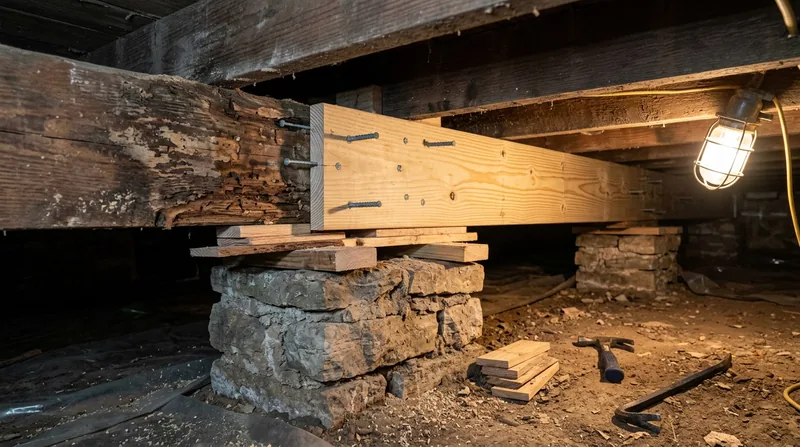




Sagging, bouncy or soft floors in Lexington's older homes usually trace to termite-damaged joists or subfloor, or to moisture rising from damp crawlspaces and fieldstone basements over Bluegrass limestone. Floor joist and subfloor repair restores the structural integrity of your floor system, eliminates the bounce and soft spots that signal decay or insect damage, and stops the problem from spreading to walls and framing above. Lexington's humid summers and wet springs, combined with freeze-thaw cycles that open joints and push water into end grain, create ideal conditions for wood rot and termite activity in the rim joists, sill plates and subfloor sections that sit closest to the ground. We sister or replace compromised joists, rebuild subfloor sections, and level floors before finishes go back down, working from moisture assessment and damage inspection to a solid, level floor you can trust. Whether your home is a Victorian in the Mentelle area, a Craftsman bungalow in Kenwick, a brick ranch in Lansdowne, or a subdivision two-story in Masterson Station, we address the root cause and get the floor right. Our goal is repair wherever the wood justifies it, and honest replacement when that's what the damage calls for.
Why Floor Joist and Subfloor Damage Matters in Lexington's Older Homes
Lexington sits on rolling limestone karst with clay soil that doesn't drain well, and most older houses stand on stone or block foundations over damp crawlspaces or fieldstone basements that take on water after heavy spring rain. That moisture migrates upward into the rim joist, sill plate and subfloor, the very members that carry the weight of your house and everything in it. Termite pressure is real in the Inner Bluegrass, and subterranean termites exploit moisture to tunnel through wood without being seen. A soft or bouncy floor is not just uncomfortable; it signals structural wood loss that will only worsen if left unaddressed, spreading into the band joists and eventually affecting walls and load-bearing framing above.
- Moisture wicking from crawlspaces and basements saturates the lowest wood members, creating rot and attracting termites.
- Termite damage hollows out joists and subfloor from the inside, leaving the surface intact but the wood structurally compromised.
- Dry rot spreads slowly but steadily through wood in poor ventilation, turning framing to powder and compromising floor levelness.
- Repeated freeze-thaw cycles open paint joints and push water into end grain on rim joists, especially on porches and exterior walls.
- Settling over clay soil twists door frames and floors in older homes, sometimes cracking joists or crushing rim framing.
Addressing joist and subfloor damage early prevents far more costly repairs to framing, walls and finishes downstream.
Key info: In Lexington's historic districts around Gratz Park and downtown, and in the Victorian neighborhoods of Bell Court and Woodward Heights, foundation moisture and termite damage are the most common causes of floor problems. A professional moisture and pest inspection report is your first step, and we work from that assessment to propose repair or replacement.
For more detail on wood decay and termite pathology, see our wood rot and dry rot repair page.
How We Repair Floor Joists and Subfloor in Lexington Homes
Our process begins with a thorough inspection of the affected area, including moisture testing, visual assessment of wood integrity and, where termite damage is suspected, reference to your pest inspection report. We expose the damaged joists and subfloor, document the extent of decay or insect damage, and determine whether repair by sistering (bolting a new joist alongside the damaged one) or full replacement is the right call. Once the structural work is complete, we rebuild subfloor sections, level the floor, and prepare the surface for flooring reinstallation. The entire process is designed to restore your floor to solid, level condition without unnecessary removal of sound wood.
- We inspect the floor from below, testing moisture levels and examining joists, subfloor, rim framing and sill plates for rot, insect damage and structural loss.
- We remove flooring and damaged subfloor sections to expose the full extent of joist damage and ensure no decay is hidden.
- We sister new joists to damaged ones where repair is viable, bolting them together and restoring load-bearing capacity without full removal.
- We replace joists entirely where damage is too extensive to repair, installing new pressure-treated or solid-sawn lumber and securing with proper fastening.
- We rebuild subfloor using plywood or dimensional lumber, fastening it securely to the joists and ensuring proper nailing pattern.
- We level the floor, shim where necessary, and prepare the subfloor surface for your choice of finish flooring.
This methodical approach ensures no damage is missed and every repair meets the structural demands of your home.
Local example: A Craftsman bungalow in Kenwick with a soft kitchen floor revealed termite damage in three joists and a rotted rim joist along the exterior wall. We sistered two joists, replaced the rim section, rebuilt 80 square feet of subfloor, and leveled the floor to within 1/8 inch across the room. The homeowner had new hardwood installed within two weeks.
For related structural work involving beams or load-bearing walls, see beam replacement and load-bearing wall removal.
Floor Joist and Subfloor Repair Methods
| Approach | Description | Best for |
|---|---|---|
| Sistering | Bolting a new joist alongside a damaged one, sharing the load and restoring structural capacity without full removal. | Partial joist loss, localized rot or termite damage, where the core of the joist remains sound. |
| Full joist replacement | Removing the damaged joist entirely and installing new pressure-treated or solid-sawn lumber, secured with proper fastening. | Extensive decay, structural failure, or where sistering would not restore adequate load-bearing capacity. |
| Subfloor patching | Removing soft or rotted subfloor and installing new plywood or dimensional lumber, fastened to intact joists. | Localized subfloor damage, rot limited to the upper surface, or moisture damage in crawlspaces. |
| Rim joist and sill repair | Replacing rotted rim joists or sill plates that sit directly on foundation and absorb moisture from below. | Moisture-driven rot at the perimeter, termite damage along the foundation line, or settling that has crushed framing. |
| Floor leveling | Using shims, new subfloor sections and careful fastening to restore floor flatness after joist repair. | Sagging floors, settlement over clay soil, or uneven floors in older homes where doors stick and flooring won't lay flat. |
The right method depends on the extent of damage, the load-bearing role of the joist and the condition of surrounding framing. We assess each case individually and recommend the approach that restores your floor most durably and cost-effectively.
Floor Joist and Subfloor Repair Cost in Lexington: What to Expect
Floor joist and subfloor repair in Lexington typically starts at $1,800 for a localized repair involving one to two joists and a small subfloor patch in an accessible crawlspace. Cost rises with the number of joists affected, the extent of subfloor replacement needed, the difficulty of access (tight crawlspaces cost more than open basements), and whether rim joists or sill plates require replacement. A room-sized repair spanning four to six joists and 150-plus square feet of subfloor generally runs $3,500 to $6,500. Complex jobs involving multiple rooms, poor access, extensive moisture remediation or structural complications require an on-site estimate.
Several factors move the cost up or down. Access to the damage is critical: an open basement with 6 feet of headroom is faster and cheaper than a 2-foot crawlspace. The species of wood matters, pressure-treated lumber costs more than standard framing but resists future rot. The number of joists and the length of rim framing involved directly affect labor and materials. Moisture conditions in your crawlspace or basement may require ventilation improvements or drainage work, which we can advise on but which may involve separate trades.
Getting two or three estimates from local carpenters is always smart. A free estimate lets you compare scope, method and price before committing. See our full pricing overview for more detail, and call (859) 710-6174 for a no-obligation assessment of your floor.
Insurance may cover floor damage if it results from a covered peril (storm, sudden water intrusion). We can help you document the damage for a claim, though we cannot promise approval or coverage of the deductible. Work with your insurer directly on eligibility.
Floor Joist and Subfloor Repair Near Me: What Lexington Homeowners Should Know When Hiring a Carpenter
Finding the right carpenter for floor joist and subfloor repair means looking beyond price to expertise, accountability and transparency about scope. A good contractor will inspect your floor thoroughly, explain what they find in plain language, and show you the damage before proposing a repair plan. They should be fully insured, provide references from recent local work, and be willing to answer questions about method and materials. Permits are often required for structural work such as replacing joists or altering rim framing, especially in historic districts or where load-bearing capacity is at stake. Your local building department (or your homeowners association if you live in a restricted community) can clarify what permits apply to your address and repair scope.
When you call for an estimate, ask about the inspection process, whether they'll expose the damage for you to see, what repair options they recommend and why, and whether permits are needed for your job. Request references from homes in Lexington, Nicholasville, Versailles or nearby towns where they've done similar work. Verify that the contractor is fully insured and ask to see the certificate. A carpenter who explains the problem and the repair clearly, who doesn't pressure you into unnecessary replacement, and who stands behind their work is the one to hire.
Ready to get started? Contact us for a free estimate, or call (859) 710-6174. We respond within 24 hours and can often schedule an inspection within a few days.
Floor Joist & Subfloor Repair in Lexington: Pricing Guide
| Service | Price | Details |
|---|---|---|
| Single joist repair or small subfloor patch | Starting at $1,800 | One to two joists sistered or replaced, up to 50 square feet of subfloor, accessible crawlspace or basement |
| Room-sized floor repair | Starting at $3,500 | Four to six joists, 150-plus square feet of subfloor, includes leveling and preparation for new flooring |
| Rim joist or sill plate replacement | Starting at $2,200 | Moisture-damaged perimeter framing, typically 10-20 linear feet, includes assessment of foundation drainage |
| Complex or multi-room job | On estimate | Extensive termite or rot damage, poor access, multiple rooms, or structural complications require on-site assessment |
| Travel and estimate | Free | No charge for in-person inspection and written estimate in Lexington and surrounding service areas within 24 hours |
Indicative pricing, the exact cost depends on square footage, finish, and site access. Free personalized estimate within 24h at (859) 710-6174.


