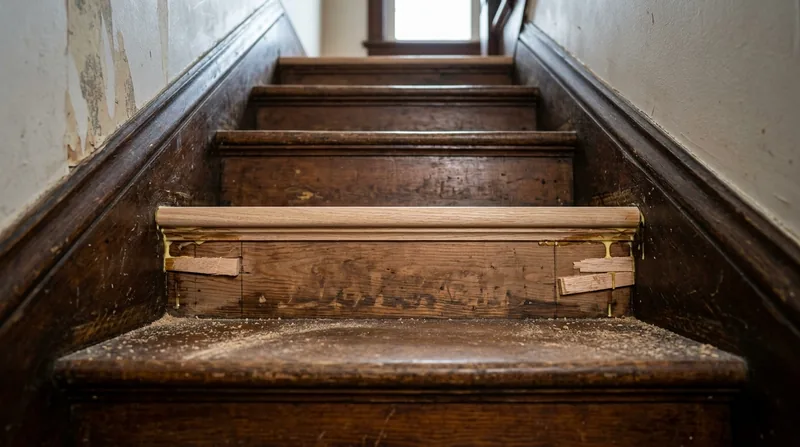




Lexington's Victorian townhouses around Gratz Park, the deep-porched Queen Anne homes in Woodward Heights, and the Craftsman bungalows along Aylesford Place all share one common feature: staircases that have climbed thousands of feet over decades, and railings that have steadied countless hands. Stair and railing repair in Lexington is not cosmetic work. Squeaky treads, loose balusters, worn stringers, and wobbly handrails are structural failures that worsen with every footfall, and they happen because of the freeze-thaw cycles that crack paint joints, the humidity that swells wood and opens glue lines, and the simple wear of daily use on stairs that were built before modern fasteners and adhesives. We repair and rebuild the staircases that define Lexington's residential character, restore period railings to their original detail, and install sturdy handrails and attic ladders that work for decades. This is where safety, craftsmanship, and local knowledge meet.
Why Stair and Railing Repair Matters in Lexington Homes
Staircases and railings in Lexington homes experience unique stresses. The city sits on limestone karst with rolling terrain, and most older houses settle over clay soil, twisting door frames and floors over time. Winter freeze-thaw cycles push water into end grain on exterior stairs and porch steps. Humidity in summer and wet springs feed rot in stringer wood, newel posts, and balusters. A loose tread is not a minor annoyance; it signals movement in the stringer, and movement compounds. A wobbly baluster means the mortise joint is failing, and failure accelerates. Building codes require railings to resist a 200-pound horizontal force, and a failing railing cannot do that.
- Squeaky treads indicate movement between the tread and stringer, often caused by wood shrinkage or fastener failure over time.
- Loose balusters and newel posts mean the mortise and tenon joints have opened, a common failure in pre-1950s construction when hide glue was standard.
- Cracked or split stringers, especially in exterior stairs, result from freeze-thaw cycles and water intrusion into end grain.
- Worn treads and risers create safety hazards and uneven steps that catch feet and strain knees.
- Missing or damaged handrails fail to meet current code and leave users without stable support on stairs and landings.
Addressing these issues now prevents falls, preserves the structural integrity of the staircase, and keeps your home's character intact.
Key info: Lexington's Victorian and Craftsman homes often have open stringers and decorative balusters that are both beautiful and vulnerable to rot and joint failure. The same freeze-thaw cycles that damage porch posts and fascia affect exterior stairs and railings on the back decks of homes in Ashland Park, Chevy Chase, and Lansdowne. Repair is almost always the right answer before replacement.
For more detail on how wood failure progresses, see our guide to wood rot and dry rot repair in Lexington, which often accompanies staircase deterioration.
How We Repair and Rebuild Stairs and Railings in Lexington
Our process begins with a clear diagnosis. We inspect the stringer for rot, cracks, and fastener failure. We check every baluster mortise and newel post joint for movement and glue failure. We test treads for squeak and measure the riser height to see if it's consistent (uneven risers are a trip hazard and a sign of settling). We examine the handrail for cracks, splits, and loose mounting. Once we know what we are dealing with, we propose repair whenever the wood justifies it, and replacement only when it does not.
- We remove loose treads and balusters, clean out old glue and debris, and re-glue and re-fasten them with modern adhesives and fasteners.
- We reinforce or sister weak stringers with sister boards bolted to the existing stringer, restoring load capacity without full replacement.
- We replace individual rotted treads or risers, carefully matching grain direction and wood species to the original staircase.
- We restore period railings by re-gluing loose joints, replacing damaged balusters, and refinishing to match the original detail and color.
- We install new handrails and code-compliant railings on stairs that lack them, using wood species and profiles that suit the home's era and style.
- We install attic ladders, pull-down stairs, and ship's ladders for access to upper storage and roof access points.
Each repair is tailored to the staircase's age, construction, and the homeowner's goals. We do not remove and replace stairs as a first step; we repair them as a first principle.
Local example: A 1920s Craftsman bungalow in Kenwick had squeaky treads and a loose newel post on its main staircase. The stringer was sound but the mortise joints in the balusters had failed because the original hide glue had lost its grip over time. We re-glued and re-fastened each baluster, replaced two treads that showed rot at the nosing, reinforced the newel post with a lag bolt through the rim joist, and refinished the entire staircase with period-appropriate stain. The repair cost a fraction of replacement and preserved the home's original character.
For related structural carpentry work, see our service page for framing and structural carpentry in Lexington.
| Repair Approach | Description | Best For |
|---|---|---|
| Re-gluing and Re-fastening | Remove loose components, clean out old glue, apply modern adhesive, and re-fasten with screws or bolts. | Squeaky treads, loose balusters, wobbly newel posts, and open mortise joints in pre-1950s staircases. |
| Sistering the Stringer | Bolt a reinforcing board alongside a weakened stringer to restore load capacity and stiffness without replacement. | Cracked, split, or sagging stringers that are otherwise sound and worth preserving. |
| Tread and Riser Replacement | Remove and replace individual worn or rotted treads and risers, matching wood species and grain direction. | Worn nosings, rot at the tread edge or riser, and stairs where only a few steps need work. |
| Baluster and Rail Restoration | Disassemble, clean, re-glue, and re-finish period railings to restore original detail and appearance. | Victorian and Craftsman homes with decorative balusters and handrails that are loose or damaged but structurally sound. |
| Full Stringer Replacement | Remove and rebuild the entire stringer in new wood, preserving the tread and riser configuration and handrail attachment points. | Stringers with extensive rot, severe cracks, or irreparable damage that cannot be sistered or reinforced. |
Stair and Railing Repair Cost in Lexington: What to Expect
Stair and railing repair in Lexington starts at around $600 for straightforward work like re-gluing loose balusters, tightening fasteners, and fixing squeaky treads on a single flight. Most interior staircase repairs in older homes run between $1,200 and $3,500, depending on how many treads and balusters need work, whether the stringer requires reinforcement, and whether rot has compromised the wood. Exterior stairs and railings, which face freeze-thaw stress and moisture, often cost more because the damage is deeper and the repair scope larger. Full stringer replacement or a complete railing rebuild can exceed $5,000, but that is rare and usually involves extensive rot or structural failure that was left unaddressed for years.
Cost is driven by several concrete factors. The number of treads and balusters that need work directly affects labor and materials. Access matters: a staircase in the middle of a home is simpler to work on than one blocked by furniture or located in a tight attic space. The wood species and age of the staircase influence how we approach repair. A 1920s Craftsman staircase with mortise and tenon joints requires different techniques than a 1970s home-built staircase with nails and simple fastening. Rot depth and extent determine whether repair is enough or replacement is necessary. Whether permits are required for structural alterations (which varies by scope and local rules) can add time and cost.
We recommend getting two or three estimates before committing. Each contractor will diagnose the staircase differently and propose different scopes. Understanding why one contractor suggests repair and another suggests replacement is part of making an informed decision. Our estimates are free and come with a clear explanation of what we found, what we propose, and why. See our full pricing guide for more context on how we structure estimates and what factors move the cost up or down.
Stair and Railing Repair Near Me: What Lexington Homeowners Should Know When Hiring
Finding the right carpenter for stair and railing repair is about more than price. You need someone who understands the age and construction of your home, who can diagnose the root cause of the failure (not just patch the symptom), and who will be honest about whether repair or replacement is the right answer. Lexington's mix of Federal-era townhouses, Victorian mansions, Craftsman bungalows, and mid-century ranches means a good contractor has experience across multiple eras and construction methods. Ask potential contractors about their experience with staircases from your home's period. Ask for references from similar projects. Request a written estimate that breaks down labor, materials, and scope so you understand what you are paying for.
Check that your contractor is fully insured. Staircase work involves heights, power tools, and structural loading, and accidents happen. Ask to see proof of general liability and workers compensation coverage. If your home is in a historic district (such as Gratz Park or the downtown historic districts), check whether the work requires approval from the local historic preservation board. Some HOAs in neighborhoods like Ashland Park and Chevy Chase have design guidelines that affect railings and exterior stairs. Confirm those requirements before work begins so there are no surprises or rework later.
Understanding permits is also important. Structural alterations to stairs or railings, or removal and replacement of stringers, may require a building permit and inspection. Requirements and thresholds vary by jurisdiction. Contact the Lexington building department to confirm whether your project needs a permit before you start. A good contractor will help you navigate that process, and if you have questions about your specific home and project, contact us for a free estimate and we can discuss what permits may apply.
Finally, do not assume that the lowest bid is the best value. A contractor who quotes $800 for a repair that two others quote at $2,000 may be missing something, or may be planning to cut corners. A contractor who takes time to inspect, diagnose, and explain is worth the conversation. Call us at (859) 710-6174 or reach out online to discuss your staircase and get a clear, no-obligation estimate.
Stair & Railing Repair in Lexington: Pricing Guide
| Service | Price | Details |
|---|---|---|
| Squeaky treads, loose balusters, and basic tightening | Starting at $600 | Re-gluing loose joints, replacing fasteners, and fixing squeaky treads on one flight of stairs |
| Interior staircase repair with some tread or baluster replacement | Starting at $1,200 | Re-gluing joints, replacing one to three treads or balusters, reinforcing newel post, interior work only |
| Exterior staircase repair or full railing restoration | Starting at $2,000 | Repair or replacement of exterior stairs, railing, handrail, or rot-damaged treads exposed to weather and freeze-thaw |
| Stringer sistering, full tread replacement, or extensive restoration | Starting at $3,000 | Reinforcing or replacing stringer, multiple treads and balusters, or period railing restoration with finishing |
| Full stringer replacement or complex structural rebuild | On estimate | Extensive rot, severe structural damage, or complete replacement requires on-site inspection and detailed scope confirmation |
| Estimate and initial consultation | Free | Response within 24 hours at (859) 710-6174, includes diagnosis, scope, and written estimate with no obligation |
Indicative pricing, the exact cost depends on square footage, finish, and site access. Free personalized estimate within 24h at (859) 710-6174.


