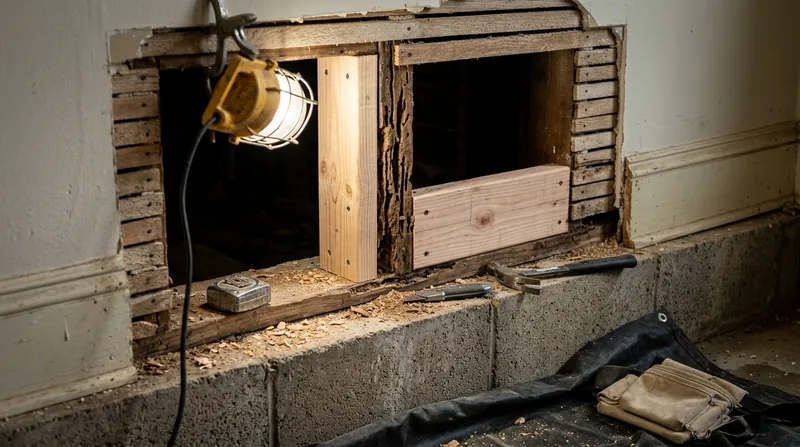




Kentucky's humid summers and damp crawlspaces keep termite damage repair a steady need across Lexington's older homes. After a pest inspector finds subterranean termites, the exterminator treats the colony, but the damaged wood remains. Studs, sill plates, rim joists, subfloor sections, and trim eaten soft by termites must be cut out and replaced to restore full structural integrity. We work from your pest inspection report, remove the compromised wood, sister new framing where needed, and close out the repair with finish carpentry that matches the home. Whether it's a Victorian porch post in Woodward Heights, a Craftsman bungalow sill in Kenwick, or a 1950s ranch rim joist in Lansdowne, the work is the same: careful removal of termite galleries, precise replacement, and restoration to code.
Why Termite Damage Repair Matters in Lexington's Older Homes
Lexington sits on rolling limestone karst with damp crawlspaces and fieldstone basements that take on water after spring rains. The combination of humid summers, wet springs, and the steady moisture that feeds subterranean termite colonies means older wood in foundations, rim joists, sill plates, and crawlspace framing is always under pressure. Once termites tunnel through wood, they hollow it from the inside, leaving thin shells that look solid but carry no load. A sill plate that looks fine on the surface may be 80 percent eaten inside. That damage compounds over time: water seeps into the galleries, dry rot sets in, and the structural member fails. Replacing the wood before it fails costs far less than dealing with settling floors, cracked plaster, or doors that no longer close.
- We identify and remove all termite-damaged wood based on your pest inspector's report and our own site assessment.
- We replace studs, joists, and sill plates with pressure-treated lumber or solid wood matched to the original species and profile.
- We sister new framing alongside existing members when the damage is partial and the remaining wood can support the repair.
- We restore crawlspace rim joists and subfloor sections to full load-bearing capacity without removing the entire floor.
- We document all work for your insurance claim, taking photographs and notes of the damage before and after repair.
The goal is to restore structural integrity so your home sits level, doors close smoothly, and floors feel solid underfoot again.
Key info: Termite damage in Lexington is most common in crawlspaces, basements, and around grade where moisture is highest. A sill plate that sits on a damp block or stone foundation can be half-eaten before any exterior sign appears. That is why a pest inspection report is your roadmap. We work directly from it, removing only what is damaged and replacing it with new wood that will not rot or attract termites if the moisture and pest issues are addressed.
For more on the relationship between termite damage and other wood rot pathologies, see our guide to wood rot and dry rot repair in Lexington.
How We Repair Termite Damage: Step-by-Step Work in Lexington Homes
Every termite damage repair starts with your pest inspection report in hand. The report tells us where the infestation is active, where the damage is worst, and which wood needs to come out. We do not treat the termites or guarantee they are gone; that is the pest control contractor's job. Our job is to replace the wood. We begin by opening up the affected area, cutting away all damaged framing, and assessing whether adjacent wood is sound or also compromised. In crawlspaces under Lexington's older homes, this often means removing sections of rim joist or band board and replacing them with new pressure-treated lumber or kiln-dried framing. On porch posts and exterior trim, we cut out the soft sections and either replace the entire member or sister a new piece alongside it if the structural load allows.
- We access the damaged area by opening crawlspace hatches, removing siding, or exposing the framing as the job demands.
- We cut out all wood showing termite galleries, soft spots, or loss of structural strength, working to a clear boundary where sound wood begins.
- We measure and mill new framing to match the original size, profile, and species whenever possible, or use pressure-treated lumber where the original is no longer available.
- We install the new wood, securing it with fasteners appropriate to the load and location, and checking level and plumb as we go.
- We sister new joists or studs alongside existing members when the damage is partial, using galvanized bolts or screws every 12 to 16 inches along the lap.
- We close out the repair with caulk, paint, or siding to match, and provide you with before-and-after photos for your insurance file.
The timeline depends on how much wood is damaged and how accessible it is. A single rim joist section in a crawlspace may take one day. A full sill plate replacement around a Victorian townhouse foundation can take three to five days.
Example: A homeowner in Chevy Chase noticed her porch floor sagging and called a pest inspector. The report found active subterranean termites in the rim joist and band board where the porch foundation sat on a damp stone base. We removed 12 feet of compromised rim joist and replaced it with pressure-treated 2x10 lumber, bolted to the existing floor frame and sill plate. The porch floor came back level, and the cost for materials and labor was $2,800. Without that repair, the porch would have continued to settle, cracking the brick facade and breaking window frames.
For more detail on subfloor and floor joist repair, see floor joist and subfloor repair in Lexington.
Repair Methods and Materials for Termite Damage
| Approach | Description | Best for |
|---|---|---|
| Full member replacement | Remove the entire joist, stud, or sill plate and install new pressure-treated or solid lumber sized to match the original. | Rim joists, sill plates, and porch posts where termite damage is extensive or spans the full depth of the member. |
| Sistering | Install a new joist or stud alongside the existing member, bolted or screwed at regular intervals, sharing the load between old and new. | Floor joists and studs where the remaining wood is sound and the damage is partial, preserving the original framing. |
| Section replacement | Cut out only the damaged portion of a long member (e.g., a 4-foot section of rim joist) and splice in new pressure-treated lumber with galvanized fasteners. | Rim joists, band boards, and trim where damage is localized and the member is long enough to splice without weakening the connection. |
| Post and beam replacement | Replace a load-bearing porch post or beam with new pressure-treated timber, securing it to the foundation and the structure above with galvanized hardware. | Porch posts, deck beams, and other exposed vertical or horizontal members carrying significant load and showing termite galleries. |
| Pressure-treated vs. solid wood | Pressure-treated lumber resists termites and rot; solid wood (redwood, cedar, or Douglas fir) is chosen when matching the original appearance is essential or the member is interior. | Crawlspace and exterior work favors pressure-treated; visible porch posts and trim favor solid wood stained or painted to match. |
Termite Damage Repair Cost in Lexington: What to Expect
Termite damage repair costs in Lexington typically start at $1,200 for a localized repair, such as a short section of rim joist or a single porch post. Most jobs range from $2,000 to $5,000, depending on how much wood is damaged, how accessible it is, and whether the repair requires sistering or full replacement. A complete sill plate replacement around a Victorian townhouse foundation can run $6,000 to $10,000 or more. The main factors that drive cost upward are the linear footage of damaged framing, the accessibility of the crawlspace or foundation area, whether new framing must be sistered or fully replaced, and whether the job requires temporary shoring or bracing to support the structure during removal and replacement.
Getting two or three estimates from local carpenters is always smart. Each contractor will assess the damage differently depending on how much of the wood they believe is salvageable and how much must come out. A thorough estimate should include a site visit, photographs of the damage, a clear list of what will be removed and what will be installed, the materials and labor cost, and a timeline. We include all of that in our free estimate, and we can help you document the damage for your insurance claim.
For a detailed pricing overview and examples of other carpentry services, visit our pricing page.
Termite Damage Repair Near Me: What Lexington Homeowners Should Know When Hiring a Carpenter
When you call a carpenter to repair termite damage, you are hiring someone to remove and replace structural framing. That is skilled work, and it matters that the person doing it understands wood, load paths, and how to make repairs that will last. Ask any contractor for references from recent termite damage repair jobs in Lexington or nearby towns like Nicholasville, Versailles, or Winchester. Call those references and ask whether the work was done on time, whether the carpenter explained the repair clearly, and whether the finished product looked and felt solid. A good carpenter will show you photographs of similar repairs, explain why certain materials or methods were chosen, and answer questions about load-bearing walls, sistering, and permits without deflecting.
Insurance coverage varies by policy. Some homeowners policies cover termite damage once the termite infestation is treated by a pest control contractor; others do not. Before you hire a carpenter, call your insurance agent and ask what your policy covers. We can help you document the damage with photographs and a written description of what was removed and what was installed, which strengthens your claim. We do not waive or absorb deductibles, but we can help you understand what the repair will cost so you can make an informed decision about filing a claim.
Structural repairs such as sistering floor joists or replacing a sill plate sometimes require a building permit in Lexington, depending on the scope and your local building department's rules. Contact the Lexington-Fayette Urban County Government's Building and Housing Department to confirm whether your job needs a permit before work begins. A carpenter experienced with Lexington homes will know when a permit is likely needed and can help you navigate the process.
Finally, ask whether the carpenter is fully insured. Request a copy of their liability and workers' compensation certificates. A professional carpenter carries insurance to protect you and your home in the unlikely event of injury or damage during the work.
Ready to move forward? Contact us for a free estimate at (859) 710-6174. We will visit your home, assess the damage, and provide a clear quote with no obligation to book.
Termite Damage Repair in Lexington: Pricing Guide
| Service | Price | Details |
|---|---|---|
| Localized termite damage repair | Starting at $1,200 | Short section of rim joist, band board, or single porch post removal and replacement, including materials and labor |
| Moderate termite damage (crawlspace or foundation) | Starting at $2,500 | Multiple sections of rim joist, partial sill plate, or floor joist sistering, typically 2 to 3 days of labor plus materials |
| Extensive termite damage (full sill plate or multiple members) | Starting at $5,500 | Complete sill plate replacement, extensive rim joist removal, or multiple load-bearing members, including temporary bracing if needed |
| Complex structural repair | On estimate | Termite damage affecting load-bearing walls, beams, or requiring engineered solutions, assessed on site before pricing |
| Travel | Included | No separate fee for travel within Lexington and surrounding service areas in central Kentucky |
| Free estimate | No charge | Site visit, assessment, photographs, and written quote provided within 24 hours with no obligation to book |
Indicative pricing, the exact cost depends on square footage, finish, and site access. Free personalized estimate within 24h at (859) 710-6174.


